Phraeon’s Courtship Claim
His Property (A Dark Vampire High School Bully Romance) (Vampire Boy Swords): Prince of Londinium (Dead Sun: Prince of Londinium (A Dark High School Bully Romance) (Vampire Boy Swords) Book 1)Phraeon’s Courtship Claim is Byron Phraeon’s public attempt to mark Clara Driscoll as his prospective bride during the ball at the Emperor’s Palace in the underground city of Londinium. What begins as a response to Clara’s shock over learning that she is the lost Empress’s child becomes a calculated display of possession: Phraeon holds her on the dance floor, kisses her cheek in front of her rivals and allies, declares that her future is with him, and invokes the rule of courtship as ritual justification. Clara rejects the claim, but the scene establishes it as a dangerous public challenge rather than a private romantic advance.
Causes and Background
Phraeon’s action occurs while Clara is reeling from the revelation that she is the lost Empress’s child. The discovery overturns her understanding of her life: she believes she was stolen and hidden in 1987, centuries before Londinium existed, and concludes that her memories and supposed family history were false. Still on the ballroom floor, she tries to control her tears and pull away from Phraeon. Instead of giving her space, he draws her closer and frames the past as finished, telling her that the future belongs with him.
The setting intensifies the pressure. The ball takes place in the Palace on Level One of Londinium, in a ballroom as large as a football field, illuminated by moonlight, crystal chandeliers, burning candles, mirrors, gold statues, and frescoes depicting figures from Greek mythology. Clara’s distress therefore unfolds before a formal court audience. The surrounding ladies in gothic dresses and men in embroidered eighteenth-century coats make her emotional exposure part of the spectacle, while Phraeon uses the public ritual of dancing to turn intimacy into political theater.
The Claim in the Ballroom
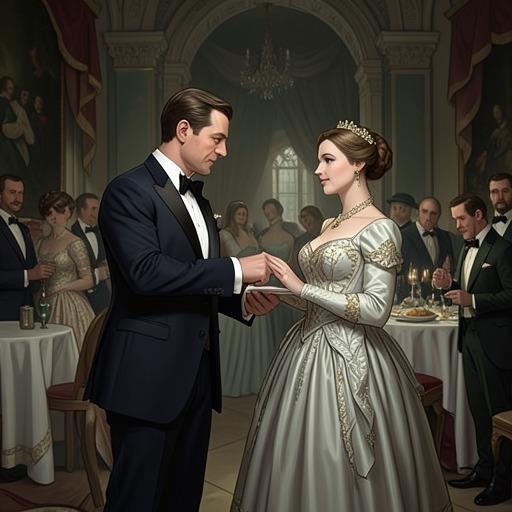
Phraeon keeps leading Clara around the wooden dance floor even as she struggles to recover herself. He presses a hand into her back, holds her tightly, and kisses her cheek with deliberate possessiveness. Clara understands that the gesture is meant to be witnessed. Darius Constantine, Prince Octavius, and Carter see the kiss; Octavius looks hurt, Darius narrows his eyes at Phraeon, and Carter turns away when Clara looks toward him. Raine also watches closely. Phraeon’s satisfaction confirms that the audience is part of his purpose: the kiss functions like a visible brand.
Clara immediately objects to the meaning imposed on her body. She warns Phraeon not to repeat the act and insists that she does not belong to him as property. He answers that she does belong to him, says that he will make her his bride, and predicts that the others—including Darius, whom he identifies as her beloved Lord Protector—will fight for her hand. He presents the contest as inevitable but his victory as certain. His language converts Clara from a shocked woman seeking composure into the prize of a competition among powerful men.
When the music ends, Phraeon releases Clara only to applaud the orchestra and then catch her hand as she tries to leave. He lifts her black silk glove to his lips and promises to keep a watchful eye over her until he can make her his. Clara snatches her hand back. The claim is thus repeated through several gestures—holding, kissing, dancing, and the ceremonial treatment of her gloved hand—rather than being confined to the first kiss.
Ritual, Rule, and Resistance
Phraeon explicitly argues that he has staked his claim according to the rule of courtship. Darius intervenes and pulls Clara behind him, and Phraeon answers that Darius has designs of his own upon her. Clara rejects the entire framework, objecting that both men speak about her as though she were an object to be owned. Her resistance identifies the central conflict of the scene: the men treat ritual recognition and romantic rivalry as authority, while Clara insists that neither can erase her agency.
Darius disputes Phraeon’s interpretation by invoking the ancient Taleian bonding ritual. Even in the muted form used at the ball, he says, Phraeon’s act is not appropriate and does not constitute the necessary bond. The later explanation of Taleian history clarifies why the disagreement matters. Taleians were divided into clans and ruled by Queen Morrigan, while the Book of Talus designated a child’s fated mate at birth. Their joining required several duels before the two mates could be united by blood and establish a psychic bond; only afterward did the male’s bite complete the union. Phraeon’s kiss is therefore a public courtship maneuver, not the full bonding process.
The same history makes the scene part of a larger system of inherited violence and supernatural law. The Druids’ curse transformed the Taleians into vampires, drove them from their lands, and scattered them among clans. In the present, the old customs survive in altered form within Londinium’s court. Phraeon invokes the custom to legitimize possession, while Darius uses its requirements to deny that the claim is complete. The argument reveals a plural order in which courtly rules, Taleian ritual, political rank, and Clara’s own refusal compete for authority.
Rivalry and Consequences
Phraeon’s claim immediately sharpens the rivalry among the men around Clara. Octavius is visibly taken aback and appears wounded by the public declaration. Darius reacts with icy anger and glares at Phraeon as though he might kill him. After Darius removes Clara from the dance floor, Phraeon continues to challenge him, asserting that Clara belongs to him. Darius instead insists that the rules must be followed and tells Clara to calm herself, addressing her as a high-ranking figure even while the confrontation continues around her.
The intervention does not restore Clara’s control. Louise Turner notices her tears, leaves the dance, and comes to her aid, offering to talk while Darius and Phraeon continue arguing. Clara’s distress has consequently produced two different responses: Louise recognizes the immediate emotional crisis, whereas the men remain absorbed in the legal and competitive meaning of the claim. Carter stays composed and offers to come and get Clara, but she signals for him to remain back because she does not want him injured.
The claim also foreshadows the later danger posed by Prince Octavius. The Taleian bonding account explains that a bite can join the fated mates by blood, and Octavius later attempts to kiss and bite Clara, while Darius warns through their psychic bond that Octavius means to take her with his bite. Clara explicitly refuses to be branded. Phraeon’s cheek kiss is less physically final than a bite, but it establishes the same threatening logic: desire is expressed through marking, and a ritualized gesture is used to make a woman’s supposed availability public.
Narrative Significance
The episode functions as a reversal of the conventional ballroom courtship scene. The dance, formal costumes, chandeliers, and ceremonial kiss resemble romance, yet Clara experiences the encounter as confinement, humiliation, and the loss of control. Phraeon’s seductive reassurance is inseparable from his grip, his refusal to release her, and his declaration that he will make her his. The courtly surface therefore conceals coercive power.
Clara’s newly exposed royal identity makes the claim politically consequential as well as erotic. She is not merely an individual at a ball; she is the hidden child of the lost Empress, a figure whose lineage places her within the succession and within the Taleian system of fated mating. Phraeon’s public gesture seeks to occupy that uncertainty before Clara can understand it herself. By refusing to accept ownership and by trying to leave, Clara exposes the gap between being recognized as a princess and being treated as a person.
The scene ends without resolution. Phraeon has not completed the Taleian bonding ritual, but he has created a public claim that Darius must contest and that Octavius cannot ignore. Clara remains surrounded by competing interpretations of her future—bride, property, royal figure, and possible mate—while her own demand to be released remains the clearest statement of consent in the encounter. The claim thus turns the ball into the first open stage for the struggle over who may define Clara’s identity and whether ritual can ever substitute for her choice.